What a Product Engineering Services Company Actually Does in a Manufacturing Program
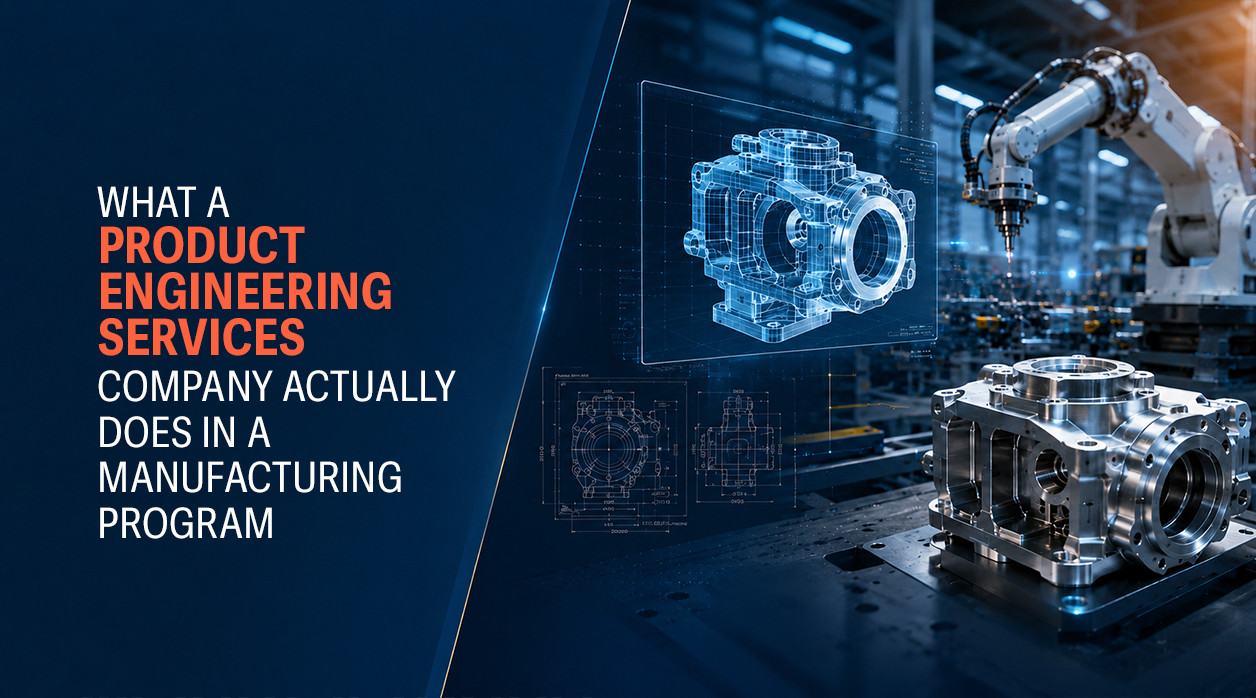
A product engineering services company owns the full chain between a product requirement and a design that can be manufactured. That chain covers geometry, material selection, simulation results, manufacturing drawings and a validated output, managed as a single connected scope from specification to production release, not as a sequence of contracted deliverables.
The programs that require this are those where requirements are complex, certification standards are non-negotiable and the cost of late-stage rework is significant. Global enterprise Engineering Research and Development (ER&D) spending stood at $1.53 trillion in 2024 and is projected to reach approximately $2.5 trillion by 2030, growing at 8 to 9% annually, according to NASSCOM’s Global ER&D Shift report. That growth reflects OEMs expanding their use of specialist engineering partners. Not because internal teams are inadequate, but because the scope of a modern product development program has grown faster than most in-house teams have been resourced to match.
What Product Engineering Design Services Actually Cover
The term ‘Product Engineering’ covers a wide range of activities across the industry. At one end, it describes CAD drafting or prototyping as standalone deliverables. At the other, it describes full design cycle ownership from concept feasibility through certified manufacturing release. The gap between those two interpretations is where programs encounter problems, when a client assumes full-chain responsibility and a supplier has scoped execution only.
Product engineering design services cover the entire development chain: industrial design and concept development, detailed product design engineering, stress and fatigue analysis using simulation tools including ANSYS, Hypermesh and LS-Dyna, value analysis and value engineering where existing designs are reviewed systematically for cost or weight reduction, and testing and validation against the load or performance specification.
Each stage of that chain places constraints on the stages that follow. A geometry decision made during concept development determines what stress concentrations will appear under load. A wall thickness that passes static analysis may fail under cyclic fatigue conditions.
Tolerance stack-up analysis addresses exactly this problem. According to Sigmetrix, a specialist in tolerance analysis and GD&T, understanding permissible variation earlier in the design process is what unites product design intent with the manufacturing reality where dimensional variation drives cost. Tolerances set unnecessarily tight drive up production cost. Set too loose, they cause assembly failures. Resolving that balance early is a structural requirement of product engineering, not an optional review step.
Where Manufacturing Programs Lose Ground
The most expensive design decisions in a product development program are not the ones that go wrong. They are the correct decisions made too late, after the architecture that constrains them has already been locked.
According to DFMA.com, the technical resource of Boothroyd Dewhurst, the originators of design for manufacture and assembly methodology, a design change at concept stage costs an engineer a few hours. The same change after detailed design involves drawing revisions, tolerance reviews and supplier notification, measured in days. After tooling is committed, the same change requires tooling modification, re-qualification and schedule compression, at a cost 10 to 100 times higher than at the concept stage.
The second structural problem is scope fragmentation. When industrial design, simulation and manufacturing drawings are contracted to separate firms, each delivers its scope. Nobody owns the chain between them. A simulation result that conflicts with a manufacturing tolerance has no single engineer who saw both and can resolve it. That conflict surfaces at prototype assembly or first article inspection, at the stage when correction carries the highest cost.
CE (Conformité Européenne) marking and PED (Pressure Equipment Directive) compliance are engineering requirements, not administrative ones. Identifying which directives apply and what they constrain in the design must happen at concept stage. According to S-GE‘s (Switzerland Global Enterprise) EU product compliance guide, identifying the correct compliance route early specifically avoids costly corrections at the point of market entry.
A product engineering services company that owns the full scope from concept through production release resolves both problems at the structural level. Simulation and manufacturing documentation are stages of one connected scope, not separate contracted deliverables handed between firms.
Product Engineering Services: What Each Stage of a Program Requires
| Program Stage | What Happens | Where Product Engineering Services Add Value |
| Concept and requirements | Product architecture defined; load cases and constraints established | Translates requirements into engineering feasibility; catches architecture problems before they become tooling problems |
| Industrial design and prototyping | Form, fit and function defined; early physical or digital models | Prototypes built to real manufacturing constraints, not just design intent |
| Detailed design and simulation | Full geometry, materials, tolerances; FEA, CFD, fatigue analysis | ANSYS, Hypermesh, LS-Dyna simulation; failure modes identified before tooling is cut |
| Value analysis and engineering | Existing design reviewed for cost and weight reduction | VA/VE methodology applied to materials, geometry and manufacturing process |
| Manufacturing drawings and DFM | Production-ready documentation: tolerances, surface finishes, GD&T | Drafting and detailed engineering aligned to the production process from the start |
| Testing and validation | Physical or simulation-based validation against specification | Testing matched to certification requirements including CE marking and PED |
Where Product Engineering Design Services Determine Program Outcomes
Not every program requires a product engineering services company to own the full chain. A component with a stable specification and a familiar production process carries limited integration risk.
The programs where full-chain ownership changes the outcome are structurally different. Consider a piece of mining equipment being adapted for a different geological environment. Load profiles change. So do thermal conditions and maintenance access requirements, and each one pulls on the others. Or take an industrial machine being redesigned for CE marking compliance under the EU Machinery Directive. The Essential Health and Safety Requirements constrain geometry, material and process choices that were already fixed in the original design, and the manufacturer has to produce a technical file documenting conformity at every stage. A hydraulic system being re-engineered to shed weight without losing load capacity is a third case. Every gram removed has to survive a simulation pass confirming that fatigue life holds under operating pressure cycles.
These are programs where the decisions made in the first weeks determine whether the product works, whether it certifies and whether it can be manufactured.
Tooltech has delivered product engineering design services across Industrial Equipment, Transportation and Energy Transformation verticals for 26 years. The work spans the full design cycle, from industrial design and prototyping through simulation, VA/VE and production-ready manufacturing documentation.
The cost of late-stage rework on a complex industrial program is not a theoretical risk. It is the predictable consequence of treating product engineering as an activity that begins after the architecture is set. Programs that deliver on schedule and within specification are those where the engineering engagement started with the requirement.
FAQs
Q: What is a product engineering services company?
A: firm that owns the full engineering chain from product requirement to production-ready design. That covers industrial design, detailed engineering, simulation, value analysis and manufacturing documentation, managed as a connected scope rather than as individual contracted deliverables.
Q: What is the difference between product engineering and product design?
A: Product design defines the intended form and function of a product. Product engineering validates whether that design works under load, survives fatigue cycles, can be manufactured to the specified tolerances and meets applicable certification requirements. One defines intent. The other proves it is achievable.
Q: When should a manufacturer bring in a product engineering services company?
A: Before the architecture is locked. The highest-leverage stage for engineering involvement is when requirements are still being translated into design constraints. After the architecture is set, a product engineering services company manages consequences. Before it is set, it shapes them.
Related Insights
Engineering Document Traceability in Regulated Man...
Know More
Robotics in Automotive Manufacturing: What Enginee...
Know More