Managing Product Variants Across Global Manufacturing Markets Without Increasing Engineering Complexity
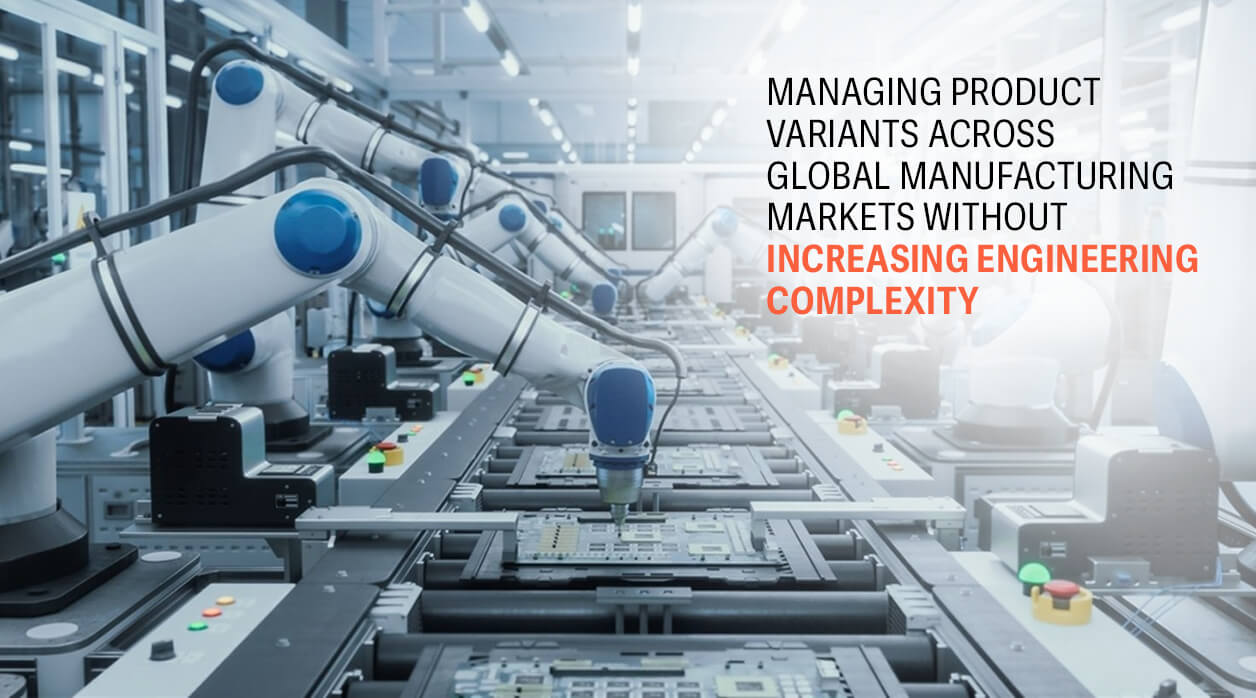
A product approved for one market usually needs changes before it can ship to the next market. Voltage standards, fastener specifications, certification requirements and labelling rules each generate a variant of their own. Managed locally, market by market, each variant accumulates a separate drawing set, a separate bill of materials and a change history visible only within that region. Global competency services address this directly: engineering distributed across markets, governed by one shared structure that every regional team works from. Without that structure, a design change approved in one market has no path back to a shared record, and a second market can build the same variant again without knowing the first one already exists.

Where Variant Complexity Comes From
Five categories account for most of the variant load a global product line carries. Each adds engineering complexity when handled separately in each market.
- Electrical and voltage standards, changing connector type, cable rating and circuit protection
- Fastener and component sourcing, where local availability forces substitutions that do not make it back into the master parts list
- Regulatory and certification requirements, including CE marking and PED compliance, which can force structural or material changes rather than paperwork alone
- Customs classification, import duty and logistics constraints, which change packaging, component choice and tariff exposure depending on the destination market’s import rules
- Language, labelling and documentation requirements, multiplying the number of controlled documents even when the underlying design stays unchanged
Hiring additional engineers in each market multiplies the number of teams solving the same driver independently, each repeating work already done in another region with no shared record connecting the two.
Coordinating Multiple Variants of One Machine Under a Single Design Programme
A shared design programme prevents that duplication. Every market variant runs through one coordinated structure, with a single team owning the master design and every regional change tracked against it.
Based on Tooltech’s case study on design automation for a glue blending machine, the equipment required modification across all of its variants, down to the sub-assembly and parts level. Each variant received its own 3D model, manufacturing drawings and bill of materials. The result was a set of machine versions, each meeting its own market’s requirements and remaining competitive within it, produced from one coordinated programme. The same case study records this contributing to an increase in client sales.
How a Global Competency Centre Keeps That Work Consistent Across Markets
A leading European shipbuilding company’s Global Competency Centre shows how this kind of coordination works in practice. Tooltech mirrored the client’s own departmental structure inside the offshore team, covering Hull and Ship Design, Interiors, HVAC and Detail Design as distinct functions, each led by a Team Leader or Project Manager aligned directly with a client counterpart. Domain experts were deputed to the client’s Scandinavian shipyard first, to learn its methodologies and standards, and some stayed on afterward as coordinators linking the offshore team back to the client. Capacity then scaled to between 50 and 100 engineers as demand grew. The same structure applies beyond shipbuilding: one team mirroring the client’s own organisation, with a defined coordination role bridging both sides. A manufacturer’s variant programme across markets faces the same coordination question a shipyard’s departmental structure does, and the same answer works.
Tooltech structures this in three stages. The first defines the engagement model and confirms feasibility. The second sets up the legal, workspace and IT foundation. The third integrates the team into the client’s own tools, processes and reporting lines, then ramps delivery to full capacity. Engagement itself runs as Build-Operate-Manage, Build-Operate-Transfer or Build-Operate-Own, depending on how much long-term ownership the client wants to retain.
Where Variant Drivers Show Up in the Design
| Variant Driver | Design Elements Affected | What a Shared Engineering Structure Prevents |
| Electrical and voltage standards | Connector type, cable rating, circuit protection | Each market branching from one master voltage record rather than redesigning the adaptation independently |
| Fastener and component sourcing | Thread standards, locally available substitutes | Approved substitutes recorded once, so every market draws from the same list |
| Regulatory and certification (CE marking, PED) | Enclosure design, material specification, labelling | Certification requirements addressed once at the design stage, ahead of any specific market’s launch |
| Customs, import duty and logistics | Packaging, component choice, tariff classification | Import and customs constraints checked once against the master design, ahead of shipment to each market |
| Language, labelling and documentation | Translated text, region-specific warnings | Content maintained centrally and issued per market, with the underlying design unchanged |
What This Requires Before Any Design Automation Investment
- A single master design and change record maintained once for the entire product family
- A defined engagement model, Build-Operate-Manage, Transfer or Own, agreed before recruitment starts
- Named ownership for each variant driver, electrical, sourcing, certification, customs and documentation
- Design automation tooling introduced only once the team and structure above already exist, to enforce rules already defined
The DFMA methodology, documented by Boothroyd Dewhurst, treats part and design commonality across a product family as a deliberate design decision. Minimising unique parts across variants keeps engineering complexity contained across tooling, assembly and field service.
The Cost Compounds One Market at a Time
A product family growing without this structure accumulates cost one region at a time, cost that stays invisible until someone totals what it took to maintain 46 independently varied versions of the same machine. Global competency services exist to prevent that pattern from repeating as the product reaches new markets.
FAQs
What causes complexity to increase when managing product variants across global manufacturing markets?
Complexity increases when variant decisions, covering electrical standards, sourcing, certification, customs and documentation, are made separately in each market rather than tracked against one shared master design and change record.
How is a Global Competency Centre different from having local engineering teams in each market?
A Global Competency Centre operates as one shared team spanning multiple markets, working from a single master design and change record that every regional variant is tracked against.
Does variant engineering always require new tooling or software?
No. Tooling formalises rules that already need to exist before implementation: shared ownership, a master design and change record and a defined engagement model. Adding tooling before agreeing these produces the same inconsistent data, at greater speed.
What does Tooltech’s variant engineering work with global manufacturers typically involve?
Modifications carried across every variant at sub-assembly and parts level, with a 3D model, manufacturing drawings and bill of materials produced for each version, as shown in Tooltech’s case study on a glue blending machine redesigned across 46 variants.
Related Insights
Engineering Document Traceability in Regulated Man...
Know More
Why Products That Go to Market Fast Often Don̵...
Know More