The Mechanical Engineering Work European OEMs Are Moving Outside Their Walls
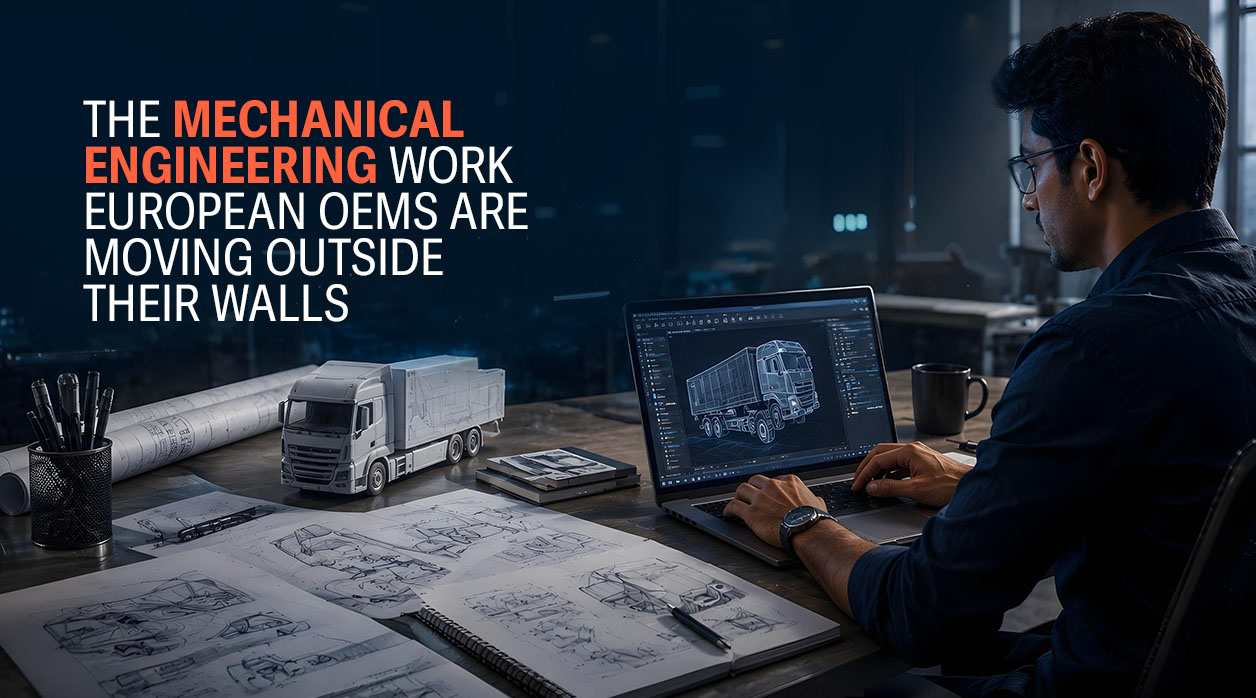
European industrial OEMs are moving a defined category of mechanical engineering work to external partners: stress simulations on approved variants, detailed drawings for market-specific configurations and drafting where the design intent is already fixed. This work requires engineering competence but not the institutional knowledge held inside the OEM’s design office. The distinction determines what belongs in-house and what does not.
The shift is changing how European manufacturers define the boundary of their internal engineering teams, and what they hand to a mechanical engineering services partner.
What Mechanical Engineering Services Are Actually Moving Outside
The work that stays in-house at most European OEMs follows a clear logic. Core intellectual property, concept architecture and the engineering decisions that define how a product competes remain internal. The remaining scope is where the boundary becomes a program-by-program decision rather than a fixed policy.
External partners take execution-stage work with a defined brief and a measurable output: detailed design of known variants, stress, fatigue and thermal analysis on conceptually approved geometries using ANSYS, HyperMesh and LS-DYNA, with outputs including FEA reports and fatigue life predictions, value analysis on existing products, new variant creation for market-specific configurations, legacy drawing migration to current CAD platforms, and production-ready drafting for manufacture. This work requires engineering competence. A simulation engineer running fatigue analysis on a mining equipment chassis is determining whether the structure survives its service life. What it does not require is physical proximity to the OEM’s design office.
The boundary is defined by control, not capability. OEMs that outsource mechanical engineering services including the architecture decisions that define their products lose design control that is difficult to recover. OEMs that outsource execution while retaining architecture and core IP retain that control while extending their capacity.
Why the Scope Is Growing
European industrial OEMs have operated under sustained cost pressure for most of the past decade. The more recent change is in the engineering scope itself.
Industrial products that were purely mechanical a decade ago now carry embedded electronic content as standard. The global industrial embedded systems market grew to USD 91.3 billion in 2024 and is projected to reach USD 118.1 billion by 2034, according to Global Insight Services. Heavy machinery now ships with sensors, embedded controls and connectivity requirements built into its design brief, placing the mechanical engineering scope alongside electrical, embedded and compliance work that did not exist in the previous product generation. On programs spanning multiple engineering locations, PLM-driven workflows handle revision control, engineering change management and configuration tracking across the full design cycle.
An in-house mechanical engineering team sized for the previous generation of products is not necessarily sized for the current one. The total scope of a modern product program has expanded faster than most internal teams have been resourced to absorb, and the work that moves to an external partner is the work that releases internal capacity for the architecture decisions only the OEM can make.
In-House vs Outsourced Mechanical Engineering Services
| Work Type | Typically Stays In-House | Typically Moves to a Partner |
| Core product architecture | Yes, defines competitive differentiation | Rarely, this is the OEM’s core IP |
| Concept design and feasibility | Yes, requires deep product knowledge | Partial, early-stage collaboration possible |
| Detailed design and drafting | Sometimes, bandwidth-limited | Often, high volume, well-defined scope |
| Stress, fatigue and thermal simulation | Sometimes, if tools and expertise exist | Often, requires specialist software and engineers |
| Value analysis and cost optimisation | Rarely with full focus | Yes, dedicated scope, measurable output |
| New variant creation | Rarely, resource-intensive | Yes, suited with the right IP controls |
| Legacy data conversion | Almost never kept in-house | Yes, clear scope, no strategic sensitivity |
| CE marking and certification support | Depends on internal expertise | Often; covers CE directives, Machinery Directive, PED and relevant ISO standards |
The India-Europe Model and What It Actually Looks Like
The India-Europe mechanical engineering services model has evolved significantly from its early form. Early offshore engagements were often structured around low-cost drafting that required extensive in-house review, and the coordination effort offset part of the cost advantage.
The current model is structured differently. An engineering partner with genuine physical presence in Europe, meaning engineers who understand the applicable standards, the certification landscape and the client’s product, operates alongside delivery capacity in India, with the European operation providing program context and the Indian operation providing scale.
NASSCOM’s Global ER&D Shift report states that offshore locations now account for close to 70% of overall engineering services delivery, with India-based providers delivering 50 to 65% cost savings over European delivery, without compromising on quality or scalability.
Tooltech Global Engineering has operated engineering offices in Germany, Finland and Sweden since 2003, alongside its India operations. It is one example of a firm whose European presence was established early rather than added later, and whose 80% engineer retention rate and no-bench model mean program context stays with the program rather than leaving with every engineer rotation.
What Most Evaluation Processes Miss
The standard criteria for assessing a mechanical engineering services partner are tools, certifications and cost per hour. These are necessary but insufficient. The criterion that predicts delivery quality more reliably is engineer continuity. A simulation engineer who has run a dozen variants of the same product chassis carries knowledge that no brief documents. An engineer who joins at variant three and rotates off at variant five does not carry that knowledge. In engineering services, retention functions as a measure of how much program context the delivery team actually retains.
This is the question most procurement processes do not ask directly. Whether the engineers who start a program are the engineers who finish it is worth establishing before a contract is signed, because the answer determines how much of the institutional knowledge built during the program stays with the program.
Related Insights

Using Whole Life Costing to Plan for Long-Term Ass...
Know More
Scaling Engineering Capacity Without Compromising ...
Know More