Product Engineering Design: Why the Sequence Matters More Than the Speed
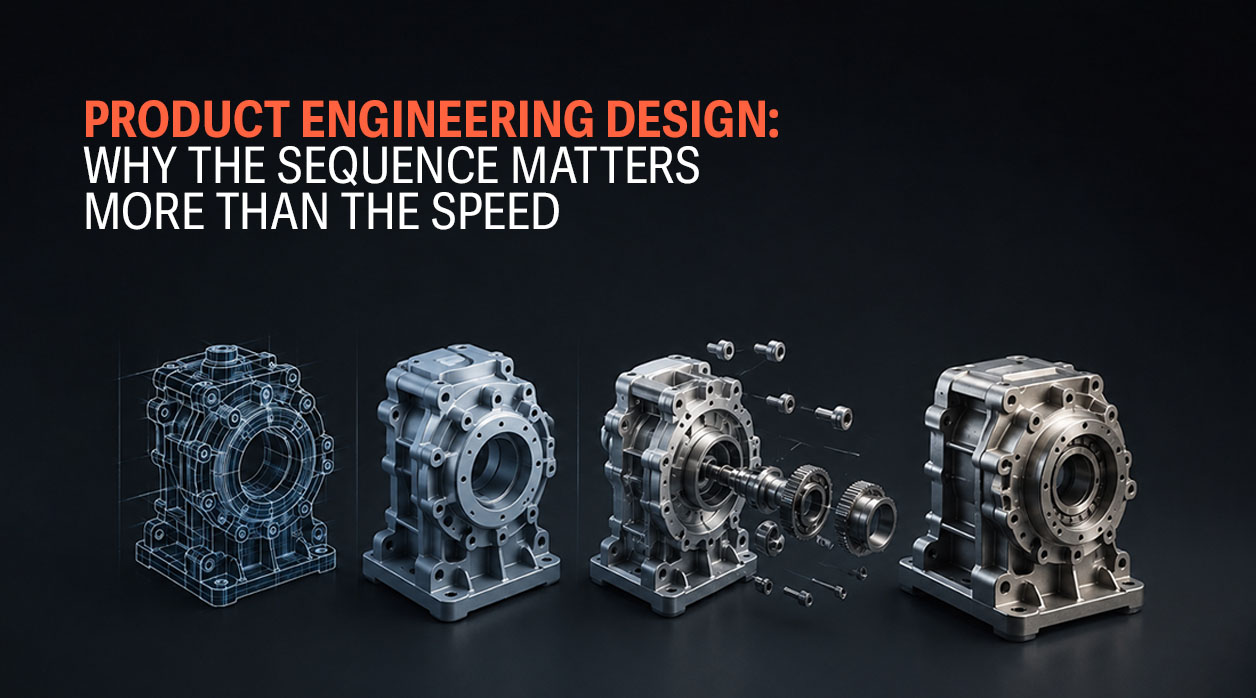
A product that reaches the market ahead of schedule and requires a major design revision within the first quarter of launch has not achieved an accelerated program. It has redistributed the engineering cost to the stage where correction is most expensive. Early milestones met through compressed feasibility reviews and deferred simulation do not eliminate those activities. They reschedule them to a point in the program where their cost is an order of magnitude higher and their impact on downstream commitments is most severe.
Where Time-to-Market Actually Gets Lost
The standard response to a program running behind schedule is to compress the back end: reduce simulation cycles, defer design reviews and move directly from concept to detailed engineering without a feasibility check. Each of these decisions transfers risk forward in the program to the stage where the cost of resolution is highest and the time available to execute it is shortest.
The cost differential between early and late-stage design changes is not marginal. According to Boothroyd Dewhurst, the originators of design for manufacture and assembly methodology, a design change at concept stage costs an engineer a few hours. The same change after detailed design involves drawing revisions, tolerance reviews and supplier notification, measured in days. After tooling is committed, the change requires tooling modification, re-qualification and schedule compression, at a cost 10 to 100 times higher than at the concept stage. Quality Magazine‘s analysis of late-stage design changes confirms the same pattern, with cascading effects across revalidation, certification rework and component scrapping once tooling has been cut. The programs that absorb these costs are not unusual. They are the predictable outcome of a development sequence where engineering decisions are made in the wrong order.
The interventions that change program outcomes are structural, not incremental. Early-stage engineering decisions cost hours to resolve. The same decisions deferred to tooling cost months. Simulation running concurrently with detailed design, rather than sequentially after it, means failure modes are identified while geometry is still adjustable. DFM analysis integrated into the drafting process, rather than applied as a final check, means tolerance decisions are made with manufacturing constraints already in view. Certification requirements mapped at the concept stage mean the technical file required for CE conformity is built progressively, not assembled under schedule pressure at the validation stage.
None of these require a longer program. They require a different sequence, one where the engineering scope is managed as a whole rather than as a set of independent deliverables.
What Product Engineering Design Services Deliver at Each Stage
At the concept stage, the deliverable is not a drawing. It is a confirmed engineering feasibility assessment: whether the proposed architecture can meet the specified load cases, the applicable certification requirements and the manufacturing constraints simultaneously. That assessment, conducted before geometry is locked, is what prevents the category of failure that surfaces at tooling.
At the detailed design and simulation stage, the sequencing decision is the critical one. Simulation running concurrently with detailed design means failure modes surface while geometry is still adjustable. The same failure modes surfacing at prototype build, after tolerances are fixed and supplier quotes are committed, carry a cost and schedule consequence that concurrent simulation eliminates entirely.
At the manufacturing documentation stage, the deliverable is a production-ready package: 2D drawings with full GD&T, material and surface finish specifications, DFM checks covering casting draft angles, weld accessibility, machining tolerances and tooling feasibility, and a manufacturing BOM aligned to the production process. For programs entering European markets, the technical file required for CE conformity is built progressively across all three stages, not assembled at the end.
What This Means for How You Structure a Program
Programs that deliver on schedule share a common structure: a requirement reviewed for completeness before concept work begins, an architecture assessed for feasibility before it is locked, simulation running concurrently with detailed design rather than following it, DFM integrated into the drafting process and certification requirements mapped before the first drawing is released. Programs that miss their final milestones despite hitting early ones share a different structure: feasibility deferred, simulation sequential, certification treated as a closing administrative step. The difference between the two is not the pace of execution. It is the sequence in which engineering decisions are made and the stage at which their consequences become visible.
A program involving the redesign of industrial equipment for a new load specification and concurrent CE marking compliance under the Machinery Directive illustrates the difference directly. Engineering involvement at the concept stage means the existing architecture is reviewed against the new load cases before geometry is fixed, the design decisions constrained by the Essential Health and Safety Requirements are identified before they become costly reversals and the tolerance and material changes required for certification are incorporated into the detailed design brief rather than retrofitted afterward. Engineering involvement after detailed design is complete means those same decisions are being unwound at the stage where unwinding them carries the highest cost.
Tooltech has delivered product engineering design services across Industrial Equipment, Transportation and Energy Transformation verticals for 26 years. The full design cycle, from industrial design and prototyping through simulation, value engineering and production-ready manufacturing documentation, is managed as a single connected scope. For programs running against European certification requirements, that means CE marking and PED compliance are mapped at the concept stage, not the validation stage. The Essential Health and Safety Requirements under the EU Machinery Directive constrain geometry, material and process choices that are difficult to reverse once detailed design has progressed. Identifying those constraints early, building the technical file progressively across the design cycle and confirming conformity at each stage is what separates a certification process that runs in parallel with the program from one that stops it.
For programs where mechanical and electrical scopes intersect, it means both disciplines are working from the same brief throughout the program rather than resolving conflicts at integration. Engineers stay on programs. The institutional knowledge built during the early stages is present at the later ones.
The difference between a product that reaches the market and one that stays there is not how fast the engineering moved. It is whether the engineering was set up to catch problems at the stage where they are still cheap.
Related Insights

Knowledge Retention Challenges in Distributed Engi...
Know More
FEA-Driven Design Validation for Complex Engineeri...
Know More