
Designing Infrastructure Assets for Long-Term Maintainability and Operational Efficiency
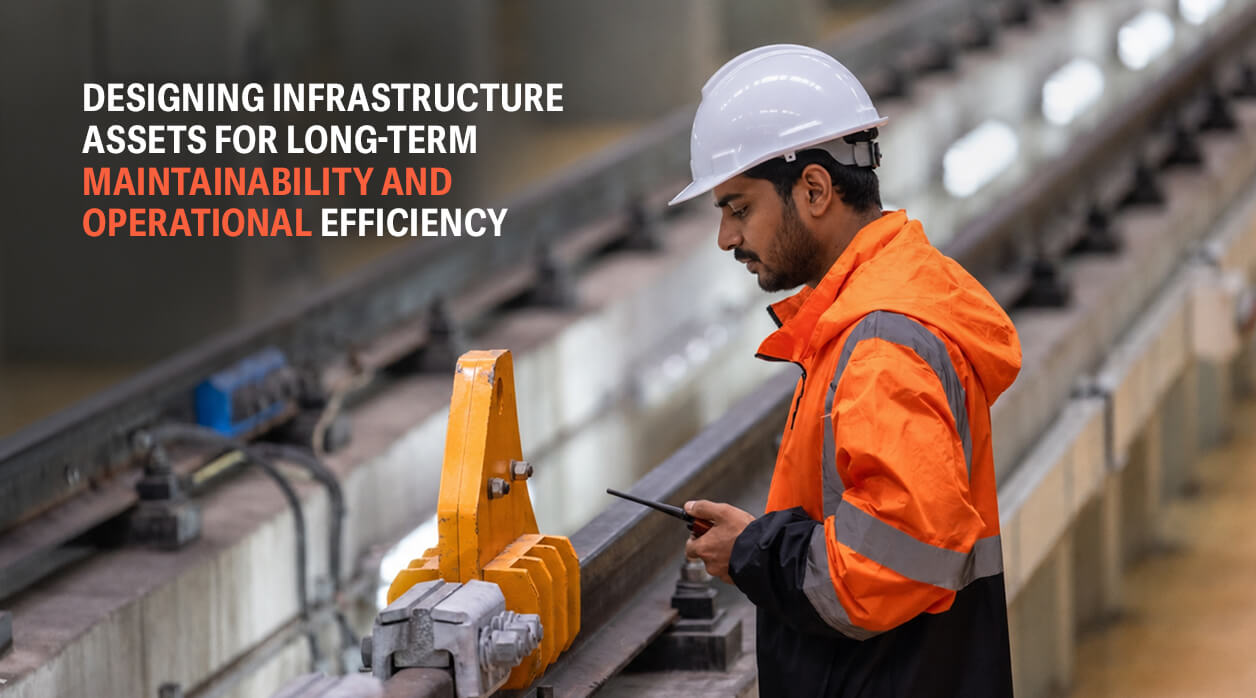
Inspection access gets designed out under programme pressure more often than it gets designed in. A hatch is sized to fit the equipment. The person and tools needed to reach it later rarely factor into that decision. Nobody notices until the component behind it needs replacing, years into operation, and the fix now means cutting into a finished structure. Engineering consulting services exist exactly to bridge this gap: the distance between what a design review approves and what an operations team lives with for the next thirty years. Handle that distance during design, and infrastructure asset maintainability becomes a design output rather than a retrofit.

The Design Decisions That Determine Long-Term Maintainability
Maintainability gets decided in the drawings, months or years before an operations manual exists to describe it. A handful of choices, made under ordinary programme pressure, account for most of what an asset costs to run afterward.
- A component specified against unit price rather than total cost of ownership, which shortens the replacement cycle below what the design assumed
- An inspection point sized to equipment dimensions alone, with no clearance allowance for the person and tools servicing it
- Systems bought from separate vendors with no shared spares strategy, which fragments the maintenance budget across catalogues that do not talk to each other
- As-built documentation treated as a project closeout task rather than a deliverable scoped from the start
Each of these decisions resurfaces years later, usually as an unplanned maintenance cost, long after the original design and construction teams have moved on. The pattern is consistent because the timing is the same in each case. The MacLeamy Curve, a framework widely used in the built-environment sector, describes this precisely: the ability to influence an asset’s functional performance is highest at the earliest design stages and falls sharply once construction starts, while the cost of changing a decision moves in the opposite direction. Reviewing maintainability after handover means asking the question at the one point in the programme where the answer is guaranteed to be expensive.
Programme Pressure Cuts Maintainability in Predictable Places
The same four decision points recur across sectors, and each has a specific failure signature.
| Design Decision | Common Shortcut Under Programme Pressure | Effect at the Operating Stage |
| Access for inspection and replacement | Space reassigned to other systems; hatch reduced or removed | Every future inspection needs extra labour or partial dismantling |
| Material and component selection | Chosen on unit price and current lead time | Replacement cycle runs shorter than the design assumed, given local climate exposure |
| Spares and vendor strategy | Each system procured from a different vendor with no shared plan | Maintenance budget splits across parts catalogues and suppliers |
| Documentation handover | As-built drawings and O&M manuals delivered late or incomplete | Operations troubleshoots without a reliable maintenance record |
A design review that checks all four before freeze catches most of what an operations team would otherwise discover on site, under pressure, without the original design team in the room.
What an Operations and Maintenance Assessment Actually Reviews
At Tooltech, that starts with a collection and review of existing O&M documentation: operating procedures and SOPs, maintenance manuals and logs, asset registers and maintenance schedules, system performance reports, and spare parts inventory and procurement records. This is benchmarked against industry best practices. The output is an identification of performance improvement areas, with recommendations covering process optimisation, training needs, upgrades or modernisation, spares and inventory strategies, and enhanced documentation and digitalisation.
For one metro operator in India, that O&M assessment revealed improvement areas across maintenance strategy, safety process, and organisational efficiency. Implementing the recommendations puts the operator on track to reduce operating costs by up to 10 percent and extend asset life by 25 percent. Both figures trace back to decisions and practices already sitting inside the operation, identified through a systematic review.
The Case for Reviewing Before the Design Freezes
The metro case makes the retrospective argument. The stronger position skips needing that assessment ten years in, because the review happened before handover instead of after. A design-stage maintainability check asks a narrower, cheaper version of the same questions:
- Every system carries a named spares strategy assigned at design stage
- Every inspection or replacement point is checked for clearance sufficient for a person and their tools
- As-built documentation is scoped and resourced as a deliverable, with an owner and a deadline
- A named receiving owner on the operations side signs off before the design freezes.
This overlaps with whole life costing, a related discipline under the same engineering consulting services line, which extends the same logic into the financial model across an asset’s full operating life. The two disciplines share a starting assumption: a decision made once during design gets paid for daily during operation.
What Changes When One Team Owns Both Sides
Project controls, forensic delay analysis, and O&M assessment sit inside the same infrastructure engagement at Tooltech rather than split across a design consultant and a separate facilities contract. That structure matters most for accountability. When the team reviewing maintenance access is the same team that approved the drawings, there is no handoff where the reasoning behind a decision gets lost.
An asset built without that continuity still works. It just costs more to keep working, in ways nobody notices until the invoices start arriving.
FAQs
What does infrastructure asset maintainability mean in practice?
It means an asset is designed so that inspection, replacement, and repair can happen without extra labour, dismantling, or guesswork, because access, materials, and documentation were checked before construction rather than after.
How is an O&M assessment different from routine maintenance planning?
Routine maintenance planning schedules known tasks. An O&M assessment audits the existing strategy itself, comparing documentation, procedures, and spares management against industry practice to find where the current approach costs more than necessary.
Why review maintainability during design instead of after handover?
Because the cost of changing a decision rises sharply once construction begins, while the ability to influence how an asset performs is highest at the earliest design stages. A review after handover can only report the cost of decisions already fixed.
Do engineering consulting services typically include this kind of review?
Not by default. Many engagements stop at design and construction support. Engineering consulting services that also cover O&M assessment and whole life costing carry the same team’s accountability through into the operating years.
Related Insights
Project Planning for Mega Infrastructure Projects:...
Know More
Using Whole Life Costing to Plan for Long-Term Ass...
Know More