
Project Planning for Mega Infrastructure Projects: Where Schedules Break
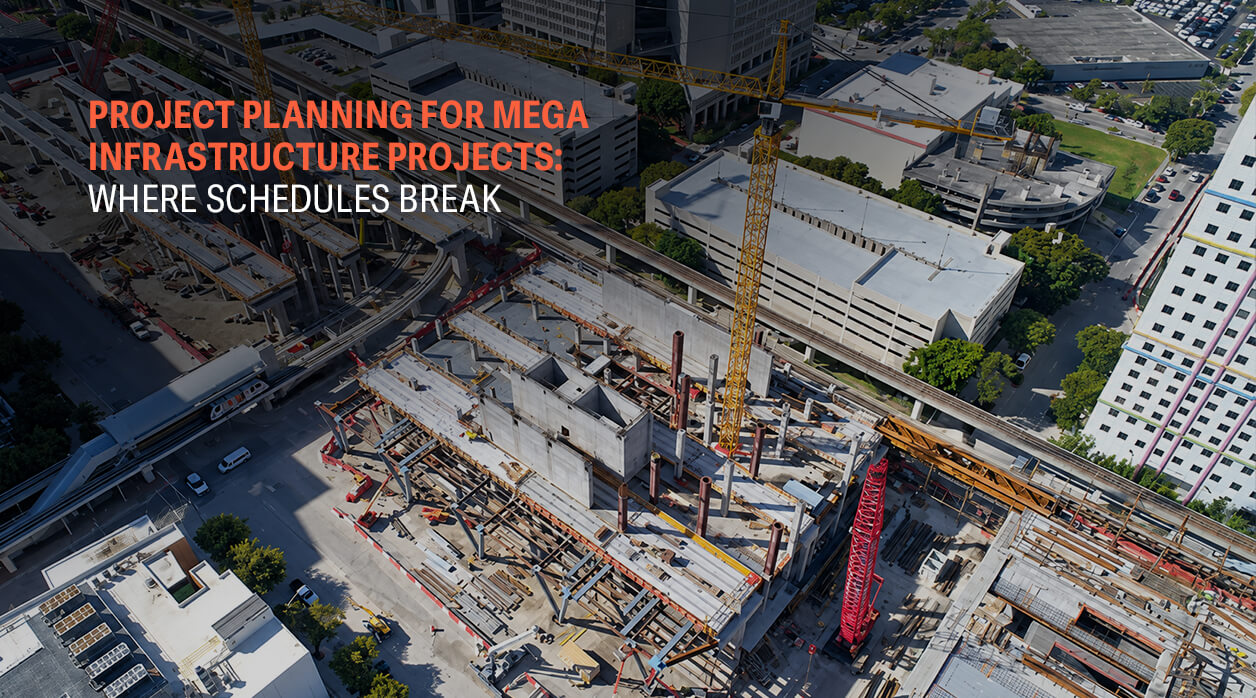
On a southwest line expansion for an Australian metro authority, a regulatory approval was tracking toward a timeline the wider programme could not absorb. The delay did not originate in the alignment, the structural design, or any process a design office controls. It originated with a regulatory authority operating on its own timeline, with no obligation to the construction schedule. That is the risk profile an engineering services company manages on a mega infrastructure programme: dependencies no design team owns, running on a timeline the programme still has to absorb regardless. Tooltech identified the risk early enough to escalate it through the right channels, reducing the resulting approval delays by 20 percent and avoiding an estimated 2 million dollars in cost overruns.
Where Mega Infrastructure Schedules Break
A schedule delay on a mega infrastructure project rarely originates in the workstreams under the most direct programme oversight. Design and construction workstreams get tracked in detail because they are contractually owned and visible on every progress report. Regulatory approvals, land acquisition and utility relocations sit outside that direct control, and a slippage in any one of them can push back a critical path that was built assuming they would clear on schedule.
On the southwest line expansion, that exposure showed up as a regulatory approval tracking toward a timeline the wider programme could not absorb. Tooltech flagged it at project initiation and worked directly with the regulatory bodies to keep communication moving, ahead of the point where the setback would have surfaced as a critical path problem on the schedule report. Forensic delay analysis is what made that early flag possible. A baseline schedule precise enough to trace how a regulatory slip would propagate through the critical path is what let the risk get identified before it became a scheduling emergency.
Catching a risk that early depends on a baseline schedule established before construction starts. Clients typically engage an engineering services company during Detailed Project Reports and tender support. A baseline built after mobilisation can no longer flag risks such as regulatory clearance timing in time to protect the programme. Resource planning at this stage fixes more than staffing numbers against a task list. It sets the durations, the sequencing logic and the dependency assumptions. The programme measures every later schedule variance against that baseline. Once that baseline is published to stakeholders, it becomes the fixed reference point for every progress report that follows.
A risk register for external dependencies works differently from a standard project risk register. It tracks entities that do not report progress to the programme at all: a land acquisition authority, a utility owner, an environmental regulator. Each entry needs an assumed clearance date, an escalation trigger if that date is missed and a named owner inside the programme responsible for chasing it. Without that structure, an external delay only becomes visible once it has already consumed the float built into the schedule.

What Project Planning and Control Covers on a Mega Programme
For an engineering consulting services provider running project controls on a mega programme, the scope Tooltech delivered on the Sydney Metro project covered:
- A comprehensive schedule mapping the sequence, dependencies and timelines for every task in the programme
- Progress monitoring against the established schedule and budget, reported through dashboards
- Variance analysis between planned and actual performance to flag where corrective action was needed
- Critical path analysis to trace how individual delays affected the overall programme timeline
- Preparation of upstream Extension of Time claims and review of contractor-submitted claims
Budget monitoring ran alongside the scheduled work throughout the programme, since a delay that looks contained on the timeline can still generate cost impact through extended site overheads and remobilisation. Tooltech prepared and monitored the project budget and generated the reports the client’s senior management used for decisions on the programme.
Dashboard reporting puts critical path status, budget variance and open regulatory dependencies in front of programme owners in one view. That matters more on a mega programme than a smaller one, since the number of interdependent workstreams makes it harder to see which single delay is driving the overall completion date.
How Delay Risk Moves Through a Mega Programme
| Programme phase | Where delay risk concentrates | Mitigation applied |
| Initiation and baseline setup | Regulatory approvals, land acquisition and permits treated as fixed dates instead of tracked risks | Risk register entries with an assumed clearance date and a named owner for each external dependency |
| Design and procurement | Design changes cascading into procurement lead times | Baseline schedule updates tied to design freeze milestones |
| Construction execution | Utility relocations and contractor sequencing conflicts | Variance analysis against planned progress, reported through dashboards |
| Handover and closeout | Disputed delay attribution between parties | Forensic delay analysis and Extension of Time claim documentation |
Mega infrastructure schedules rest on assumptions about external dependencies. Those assumptions carry the real risks of the programme. Regulatory bodies, utility owners and land authorities do not report into the programme. A schedule that treats their timelines as fixed inputs rather than tracked risks becomes exposed the moment one of those timelines shifts. Delay attribution after the fact is expensive to dispute and difficult to prove. Forensic delay analysis exists specifically to address that problem. Tracking the exposure before it becomes a dispute, costs less than winning the claim afterward. A programme director who can point to a dated risk register entry has a defensible position with a client or a regulator. One relying on memory of when a concern was first raised does not.
Frequently Asked Questions
What is the difference between project planning and project scheduling on a mega infrastructure programme?
Scheduling produces the sequence of tasks, dependencies and dates. Planning includes scheduling but also covers resource allocation, risk registers for external dependencies and the governance structure that decides how delays get escalated. A programme can have a detailed schedule and still lack the planning discipline to act on it when a regulatory approval starts slipping.
Who is responsible for cost overruns caused by a regulatory delay outside the contractor’s control?
This is typically defined in the contract through Extension of Time provisions. That is the area engineering consulting services are built to support through forensic delay analysis and EoT claim documentation, since responsibility usually comes down to when a delay was identified, what mitigation was attempted and whether that record was kept at the time rather than reconstructed afterward.
How early should forensic delay analysis start on a mega infrastructure project?
At project initiation, before a delay has appeared on a progress report. On the southwest line expansion, the regulatory risk was flagged at the initiation phase, before it had shown up as a schedule variance at all, which is what made the eventual 20 percent reduction in approval delays possible. Waiting for the schedule report to show the problem means the mitigation window has already closed.
Related Insights

Managing Product Variants Across Global Manufactur...
Know More
Balancing Weight, Durability, and Manufacturabilit...
Know More