
Balancing Weight, Durability, and Manufacturability in Construction and Mining Equipment Design
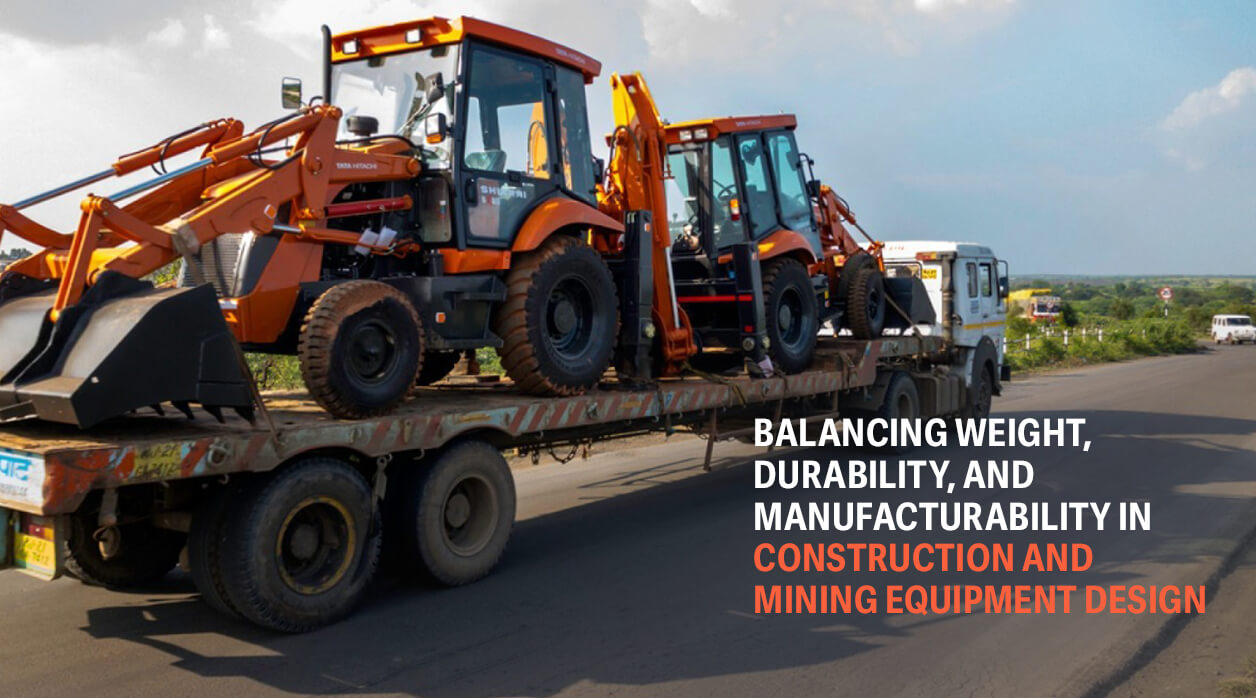
A thicker bucket wall survives another season of abrasive rock, but it also changes the transport permit and the crane sizing booked for site assembly. A thinner wall built for manufacturability ships faster and at lower cost, and can cut wear life on a mining site from a full season to a few months. Weight, durability and manufacturability rarely move independently in construction and mining equipment design, and a change to one nearly always forces a decision on the other two. Project management consulting services earn their place on a heavy-equipment programme exactly at that point, translating a design trade-off into a schedule and logistics decision before it reaches the site.
A heavier design is not automatically the safer choice, and a lighter one is not automatically the cheaper one, once the whole programme is priced in. Added mass changes the foundation a mining conveyor needs, the crane capacity a site has to book, and the transport permit a fabricator has to file before a unit leaves the shop. Reduced mass cuts fabrication time and material cost, but also cuts the wear allowance an abrasive site burns through in the first year. Neither direction is free.
Why These Trade-offs Need Project Management Consulting Services
Four trade-off blind spots turn up more often than any others.
- Weight decisions made without checking transport and site lifting constraints, where a wall-thickness increase for wear life pushes the assembled unit over the crane capacity or permitted road weight booked for the site.
- Durability specifications are set without a wear-life target tied to the actual site condition, so two units built to the same drawing perform differently depending on whether they are deployed in a quarry or an indoor plant.
- Manufacturability changes made late, after tooling and fabrication sequencing are already locked, that reduce assembly time on paper but require a supplier change nobody scheduled for.
- Trade-off decisions never checked against the delivery schedule at all, so a durability upgrade that adds two weeks of fabrication time only becomes visible once it collides with a fixed site mobilisation date.
On a skid steer loader indigenised for the Indian market, weight reduction was delivered alongside a redesigned chassis, cabin and arm structure, improved stability and fitment, better ergonomics and provision for an AC cabin, using 3D scanning and reverse engineering of the existing equipment, with complete 3D models, 2D manufacturing drawings and a bill of materials as the final output. Weight, stability and fitment do not move independently on a redesign like that, a change to one tends to carry through to the other two.
The Cost of Deciding These Trade-offs Without a Schedule View
A weight increase caught at the design review stage costs a line in a transport study. The same increase caught after fabrication costs a re-permitted route, a different crane booking, or a foundation redesign at a site that has already been mobilised. Durability decisions carry the same risk in reverse. A wear-life target that turns out too conservative once the machine is in a quarry costs a warranty claim and a field retrofit.
Programme schedules for heavy equipment builds tend to size fabrication time around the drawing as issued, not around how many trade-off decisions are still open when fabrication starts. A durability upgrade decided after tooling is committed does not just add engineering hours. It adds a supplier conversation, a lead-time check and, often, a date that has to move.
How PMC for Construction Projects Tracks These Trade-offs
PMC for construction projects exists to catch this kind of trade-off before it reaches site, tracking a design decision as a schedule and logistics item from the point it is made, not after the drawing releases to fabrication. Project management consulting services built around dashboards, baseline schedules and variance tracking are equipped to flag a durability upgrade the moment it threatens a fixed mobilisation date.
On the Sydney Metro project, planning and control work developed a schedule outlining the sequence of activities, dependencies and timelines for each task, monitored progress against that schedule and the budget, analysed variances between planned and actual performance, and prepared upstream Extension of Time claims alongside reviewing contractor-submitted claims. That is the same discipline a weight, durability or manufacturability decision needs, applied to a design trade-off instead of a construction milestone.
For a programme manager sequencing a heavy-equipment build against a fixed site mobilisation date, the relevant question is not whether the design team can defend a weight or durability decision on engineering grounds. Most can. The relevant question is whether that decision was checked against the transport plan and the crane booking before it was locked in, or checked for the first time when the unit fails to fit the truck.
Design reviews confirm that a wall thickness meets a strength calculation, a material choice meets a wear specification, a weight figure sits inside a stated tolerance. They were never built to confirm that the same weight figure still fits the crane already booked for the site, or that a durability upgrade still lands inside a fabrication window that has not moved. Tracking that is a schedule discipline, not a design one. The earlier a trade-off decision sits inside the same programme view as the transport plan and the mobilisation date, the fewer surprises show up once the unit is due on site.
FAQs
Why does a weight or durability decision that makes sense in design review still cause problems later in the project?
Because a design review checks the decision against an engineering standard, not against the transport plan, the crane capacity booked for site or the fabrication schedule. A wall thickness increase can be structurally sound and still push a unit over a transport weight limit nobody rechecked once the design changed.
Is PMC for construction projects only about schedule and budget, or does it touch engineering trade-offs like this?
It touches decisions that change the schedule, cost or logistics of the project, which a weight, durability or manufacturability change usually does. The engineering decision stays with the design team. Tracking what that decision does to the rest of the programme is where PMC has a role.
What should we look for in project management consulting services handling a heavy-equipment build?
A team that tracks design trade-offs as schedule and logistics items from the point they are made, not just cost and timeline. Ask whether the team checks a weight or durability change against the transport plan and crane booking before it is locked in, or only once the unit is ready to ship.
Related Insights

Using Whole Life Costing to Plan for Long-Term Ass...
Know More
Managing Design Coordination Between Civil, Struct...
Know More