
Managing Design Coordination Between Civil, Structural, MEP, and Instrumentation Disciplines

A structural drawing can pass every internal check and still collide with a duct run nobody modelled against it. Civil, structural, MEP and instrumentation each clear their own review on their own schedule, and each one looks complete in isolation. The clash shows up later, usually once steel is already ordered or a foundation is already poured, because no single review ever tested the four disciplines against each other. Product engineering services that treat a plant or an equipment package as one deliverable, not four separate drawing sets, are built to catch that clash before it reaches the site.
Civil typically sizes the foundation before the equipment vendor has locked a final footprint. By the time structural routes steel around that footprint, the electrical layout beneath it has already gone through two more revisions that instrumentation has not seen yet. MEP, meanwhile, runs ductwork and cable tray against the architectural shell rather than against the process piping instrumentation still needs to route through that same volume. Each discipline produces a drawing that is correct on its own terms. None of them is checked against the other three in the same model.
Where Product Engineering Services Break Down Between Disciplines
Coordinated design work at this scope covers more than one discipline’s drawings. It includes mechanical design tasks such as facade and skid design, electrical and instrumentation design, and MEP design covering electrical systems, plumbing, HVAC and fire protection, delivered as one service rather than four separate contracts with four separate review cycles.
Four coordination gaps turn up more often than any others.
- Foundation and skid footprint mismatches, where civil finalises a foundation layout before the equipment vendor locks the final skid footprint, and nobody reconciles the two until concrete is already scheduled.
- Cable tray and structural steel clashes, where MEP routes tray along a beam line that structural has not yet finalised, and nobody checks the tray drawing against the latest steel revision.
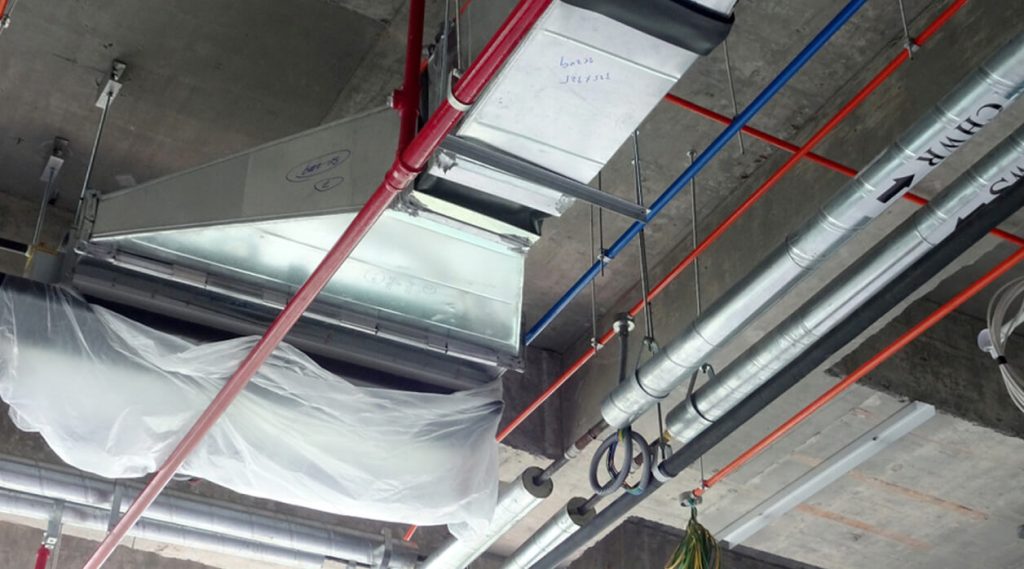
- Instrumentation routing through volumes MEP already claimed, where process piping and instrument cabling both need the same overhead run and neither discipline’s drawing shows the other occupying it.
- Access and maintenance clearance conflicts, where structural steel or ductwork ends up routed through the clearance envelope a piece of equipment needs for future service, invisible until someone tries to pull the equipment for maintenance.
On a plant layout project for a press systems manufacturer, that kind of clash was caught before it reached fabrication. The team built the layout in AVEVA PDMS and ran 3D clash detection against the client’s DIN-standard requirements, working from AutoCAD and PDF inputs from the client’s own design team, with onsite and offshore engineers checking the same model rather than separate drawing sets. Clash detection at that stage catches exactly the kind of structural and equipment mismatch a single-discipline drawing review has no way to see, before the steel is cut.
The Cost of Coordinating Late
A clash caught in the model costs an afternoon of redesign. The same clash caught on site costs a fabricated steel member that no longer fits, a foundation that has to be cored for a conduit nobody planned for, or an equipment delivery that sits on a truck because its footprint does not match the slab beneath it. That rework carries a schedule cost as well, and a fixed installation window rarely has slack built in for it.
Project schedules for EPC and infrastructure work tend to size the design phase around each discipline’s own drawing count, not around the number of times those drawings need to be checked against each other. That is where a coordination gap turns into a programme risk instead of a drafting inconvenience.
Why a Product Engineering Services Company Owns the Whole Package
A product engineering services company that only reviews each discipline’s output at handover has no way to catch a foundation-footprint mismatch before it is built. The value sits in a shared model, not a shared deadline. The same team that sizes the foundation also checks it against the equipment vendor’s footprint, the cable tray routing and the instrumentation drawings, inside one coordinated file rather than four.
On a hydrogen refuelling station project for a German manufacturer, mechanical, electrical and instrumentation engineering ran under one coordinated scope rather than three separate handoffs. The work spanned P&ID development, fluid layouts and safety valve sizing on the process side, HAZOP studies and PED, ATEX and CE compliance threaded through the whole design, and electrical circuit and layout design with SIL evaluations run against the same mechanical CAD model, including the 3D piping and ex-zone documentation.
For a project director evaluating an outsourced design package, the relevant question is not how good each discipline’s drawings look on their own. Most do. The relevant question is whether the same organisation checked those drawings against each other before they reached site, or whether that check is happening for the first time during construction.
Paper checks confirm that each discipline’s drawing is internally correct: right standard, right layout, right BOM. They were never built to confirm that a foundation still matches an equipment footprint that changed three revisions ago, or that a cable tray and a piece of structural steel occupy the same fifty centimetres of a plant without either drawing showing it. Coordinated design work closes that gap. The earlier those four disciplines sit inside the same model, the fewer conflicts show up once fabrication starts.
FAQs
Why do civil, structural, MEP and instrumentation designs clash even when each one passes review on its own?
Because each team checks its design against its own discipline’s codes, not against the other teams’ drawings. Civil can accurately dimension a foundation for load, while MEP routes a cable tray strictly to electrical code. Both are correct in isolation. However, unless those separate drawings are actively layered into a single 3D model, two disciplines can easily claim the exact same physical space and the conflict stays invisible until construction begins.
Is product engineering services coordination just a documentation exercise, or does it change the design itself?
It changes the design. Clash detection between disciplines routinely forces a foundation, a tray route or a piece of structural steel to move before fabrication. The fix happens in the design itself. The documentation only records it afterwards.
What should we look for in a product engineering services company handling multidiscipline coordination?
One team and one model, not four teams handing off drawings at the end. Ask whether civil, structural, MEP and instrumentation are checked against each other continuously through design, or only once at a coordination review near the end of the project.
Related Insights

Scaling Engineering Capacity Without Compromising ...
Know More
What a Product Engineering Services Company Actual...
Know More