Engineering Hydrogen Infrastructure for the Next Energy Transition
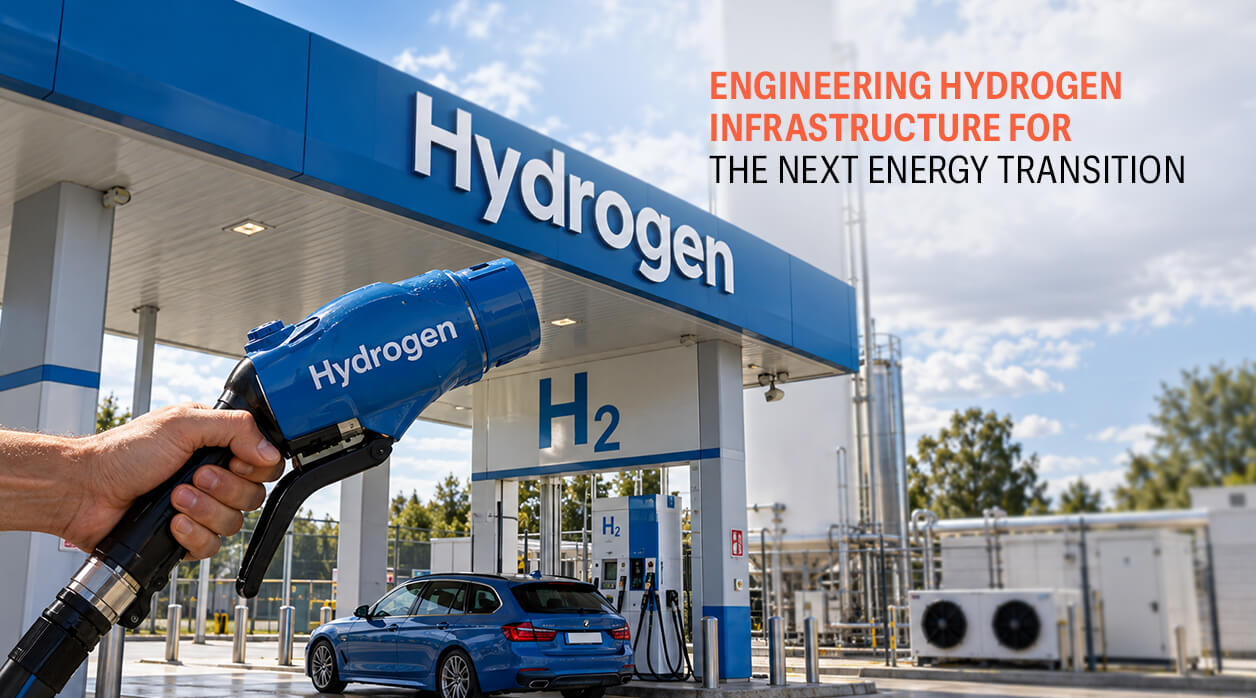
A hydrogen dispenser holds gas at pressures where a safety valve has to be sized correctly on the first pass. A rating that is off by even a small margin surfaces during certification review, when the component list is already treated as final and a redesign costs real time. This is what a mechanical engineering services company handles on hydrogen infrastructure: valve sizing, zone classification and certification documentation as one connected scope.
Tooltech’s Energy Transformation vertical frames this work under the broader theme of Decarbonisation, Decentralisation and Digitalisation: hydrogen refuelling station and equipment design; structural design of hydrogen dispensers and fuelling equipment; high-pressure storage, piping layout and safety systems; integration of sensors and instrumentation; and compliance with ISO and local safety standards.
One engagement under that vertical, for a German manufacturer of hydrogen filling stations, ran the full design cycle of the refuelling infrastructure, from conceptual layouts through certified documentation, across mechanical, electrical and instrumentation engineering domains. A hydrogen station does not separate cleanly into disciplines the way a conventional fuel pump does.
What Mechanical Engineering Design Services Cover on a Hydrogen System
Mechanical engineering work on a hydrogen system starts at the piping and instrumentation diagram. Every downstream decision, whether dispenser layout, valve selection or structural support, traces back to what the P&ID defines as the flow path. On the German engagement, Tooltech’s mechanical engineering scope covered P&ID development, fluid layout design and safety valve sizing, followed by HAZOP studies that tested the design against failure scenarios before a single component reached procurement. The Energy Transformation vertical lists structural design of hydrogen dispensers and fuelling equipment under the same broader scope, though the case record for the German engagement itself does not confirm that specific line item as part of what was delivered there.
Hydrogen Equipment Does Not Respect Discipline Boundaries
A hydrogen refuelling station couples mechanical containment with electrical instrumentation more tightly than most industrial equipment. Sensors monitor pressure and leak detection continuously, and any electrical component near the gas path needs a rating matched to the zone it occupies. On this engagement, Tooltech delivered electrical circuit and layout design alongside SIL evaluations, assessments that set how much redundancy a given control loop requires, and completed mechanical CAD modelling that included the 3D piping runs and ex-zone documentation.
Ex-zone documentation records which equipment is qualified for use inside a classified zone, and a change to that boundary after the design has been frozen can force a component swap late in a programme. None of these disciplines can advance independently on hydrogen equipment. A change to a valve’s pressure rating changes its footprint, which changes the layout, which changes where a sensor can physically sit, the kind of interdependency the German engagement’s combined scope was built to manage. Tooltech’s team covered process, electrical and mechanical specialisms together, which is why the same multidisciplinary scope supports both green and blue hydrogen infrastructure.
What PED, ATEX and CE Each Govern on a Hydrogen System
Compliance on a hydrogen system runs across three standards that govern different aspects of the same equipment. Treating them as one checklist entry is where design timelines slip.
| Standard | What It Governs on a Hydrogen System |
| PED (Pressure Equipment Directive) | Design and manufacture of pressure-bearing components: storage vessels, piping and safety valves |
| ATEX | Equipment and protective systems for the explosive atmosphere created by hydrogen leakage, including zone classification |
| CE Marking | The overall conformity declaration confirming the assembled station meets applicable EU directives before it can be placed on the market |
A zoning decision under ATEX can force a change to equipment placement that a mechanical layout alone would not anticipate. Where the same scope covers both the mechanical CAD and the compliance documentation, as it did on the German engagement, that kind of change surfaces inside the design process rather than after a component list has already been treated as final.
Missed zone classifications rarely surface in a design review. They surface later, in a certification audit, when a component list already treated as final turns out to sit in the wrong zone.
A Mechanical Engineering Services Company Built Across Two Regulatory Regimes
Tooltech has held a physical presence in Germany, Finland and Sweden since 2003, alongside its headquarters in Pune. That structure matters more on a hydrogen project than on most mechanical assignments, because the equipment often needs to satisfy European standards even when it ships to a market that does not mandate them outright. Engineers who have worked PED and ATEX compliance from inside Europe, rather than from a translated specification, catch the zoning and pressure-rating implications earlier in the design. The same bidirectional structure is what lets Tooltech help Indian clients meet European regulatory norms, including CE marking and PED compliance, on any equipment programme, hydrogen included.
Hydrogen infrastructure rewards a design team that treats mechanical, electrical and compliance work as one coordinated sequence, not three workstreams reconciled at the end. That is the discipline mechanical engineering design services bring to a dispenser or a storage skid: the valve rating, the zone classification and the CAD layout arrived at together, not stitched together as a separate step. The German engagement covers a single refuelling station. The same coordination discipline is what any hydrogen storage or distribution programme needs as its scope grows, since the number of zoning decisions grows with it.
Frequently Asked Questions
Does hydrogen refuelling station design differ for green and blue hydrogen infrastructure?
The production method sits upstream of the mechanical design. Tooltech’s scope on the German engagement covered the station and dispensing equipment itself, work that applies to green and blue hydrogen supply alike, since both feed into the same pressure-rated storage, piping and dispensing systems downstream.
How does compliance work stay on schedule instead of becoming a separate phase at the end?
It depends on when the compliance work starts. Running PED and ATEX requirements alongside the mechanical design, rather than after it, is what keeps documentation from becoming a bottleneck late in the programme. On the German engagement, HAZOP studies and PED, ATEX and CE compliance sat within the same overall design scope as the mechanical and electrical work, rather than as a separate downstream service.
What software does Tooltech use on a hydrogen infrastructure project?
On the German hydrogen refuelling station engagement, Tooltech used Autodesk Inventor, Eplan Suite, PHA_works, Conval and Infor across the mechanical, electrical and compliance documentation work. Tooltech is a software neutral organisation, so the specific stack on a hydrogen project may vary depending on the client’s own tools and standards.
Related Insights

The Mechanical Engineering Work European OEMs Are ...
Know More
Balancing Weight, Durability, and Manufacturabilit...
Know More